
TLDR: A recent study significantly improves the performance of iron-based superconductors, specifically SmFeAsO1–xHx, by quadrupling the depairing current density. This achievement opens new possibilities for practical applications but comes with challenges that need further exploration.
In a recent breakthrough, researchers have managed to dramatically enhance the performance of an iron-based superconductor, SmFeAsO1–xHx, by quadrupling its depairing current density (Jd). This is a significant achievement in the field of superconductivity, where increasing the critical current density (Jc) is crucial for real-world applications. The new approach combines thermodynamic tuning with traditional defect engineering, offering a pathway to higher performance levels that were previously thought unattainable.
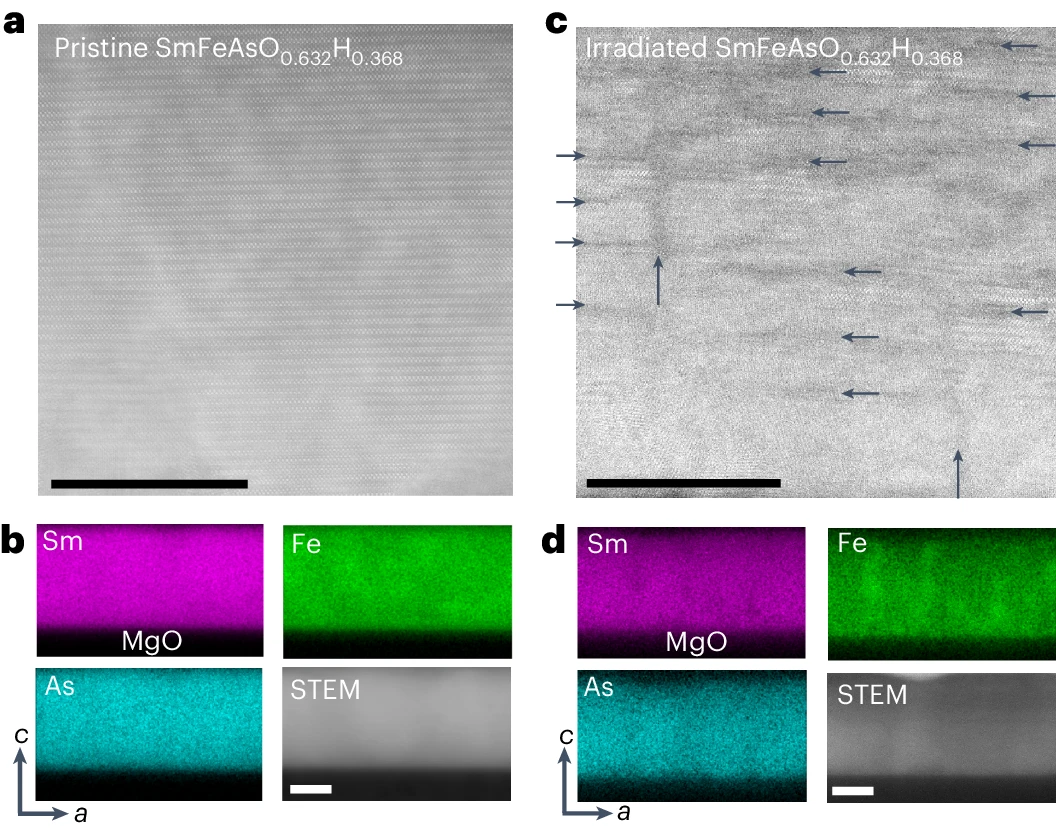
Figure: a, Cross-sectional STEM image of the pristine film. b, Elemental maps of the pristine film and low-magnification STEM image. Sm, Fe and As were homogeneously distributed in the matrix; maps collected using EDS. c, STEM image of the film after proton irradiation, revealing that irradiation introduced defects oriented along both the c axis and ab plane. d, Elemental maps and low-magnification STEM image of the irradiated film. All scale bars, 20 nm. The vertical and horizontal arrows indicate the nano-sized defects.
Superconductors, materials that conduct electricity without resistance, are highly sought after for various advanced technologies, from MRI machines to particle accelerators. However, a major challenge has been to push the boundaries of how much current these materials can carry without losing their superconducting properties. The depairing current density sets this ultimate limit, and until now, most strategies to increase Jc were capped at around 30% of Jd. This study, however, demonstrates that by carefully manipulating the material’s properties, this ceiling can be raised significantly.
The researchers used a novel approach by increasing the carrier density through high electron doping, which reduced the penetration depth and coherence length of the material. This led to a substantial increase in Jd, allowing the material to sustain much higher current densities. Additionally, by introducing defects through proton irradiation, they were able to further enhance the critical current densities, even under strong magnetic fields.
While this advancement is promising, it also raises some critical questions. The reliance on doping and irradiation to achieve these results could introduce complexities in material consistency and scalability. The delicate balance between enhancing Jc and maintaining the material’s structural integrity is a challenge that must be carefully managed. Furthermore, the real-world applicability of these findings will depend on whether the same improvements can be achieved in larger-scale production and under varying environmental conditions.
In conclusion, while the quadrupling of the depairing current density in SmFeAsO1–xHx is a significant milestone, it also highlights the ongoing challenges in the quest to make superconductors more practical for everyday applications. Future research will need to focus on addressing these challenges, particularly in ensuring that the material’s performance can be reliably replicated and scaled.
Research source: Miura, M., Eley, S., Iida, K. et al. Quadrupling the depairing current density in the iron-based superconductor SmFeAsO1–xHx. Nat. Mater.(2024). https://doi.org/10.1038/s41563-024-01952-7
Here are some homework questions based on the research:
- What is depairing current density (Jd) in superconductors? Why is it important?
- How does adding more electrons (increasing carrier density) change the superconducting properties of SmFeAsO1–xHx?
- What is vortex pinning in superconductors, and how does adding defects help increase the critical current density (Jc)?
- How does the performance of SmFeAsO1–xHx compare with other superconductors like cuprates in terms of Jd and Jc?
- What might be some problems when trying to apply the methods used in this study to larger-scale production?
- How could the findings from this study be useful in real-world technology that uses superconductors?
- What techniques did the researchers use to measure Jd and Jc in SmFeAsO1–xHx films? Why are these measurements important?
- Explain how defects created by proton irradiation help in holding back (pinning) magnetic vortices in the superconductor.
- Why does reducing the penetration depth and coherence length improve the superconductor’s performance?
- The paper mentions Ginzburg–Landau theory. What does this theory say about how to increase Jd in superconductors?
 Materials Weekly
Leave a comment