
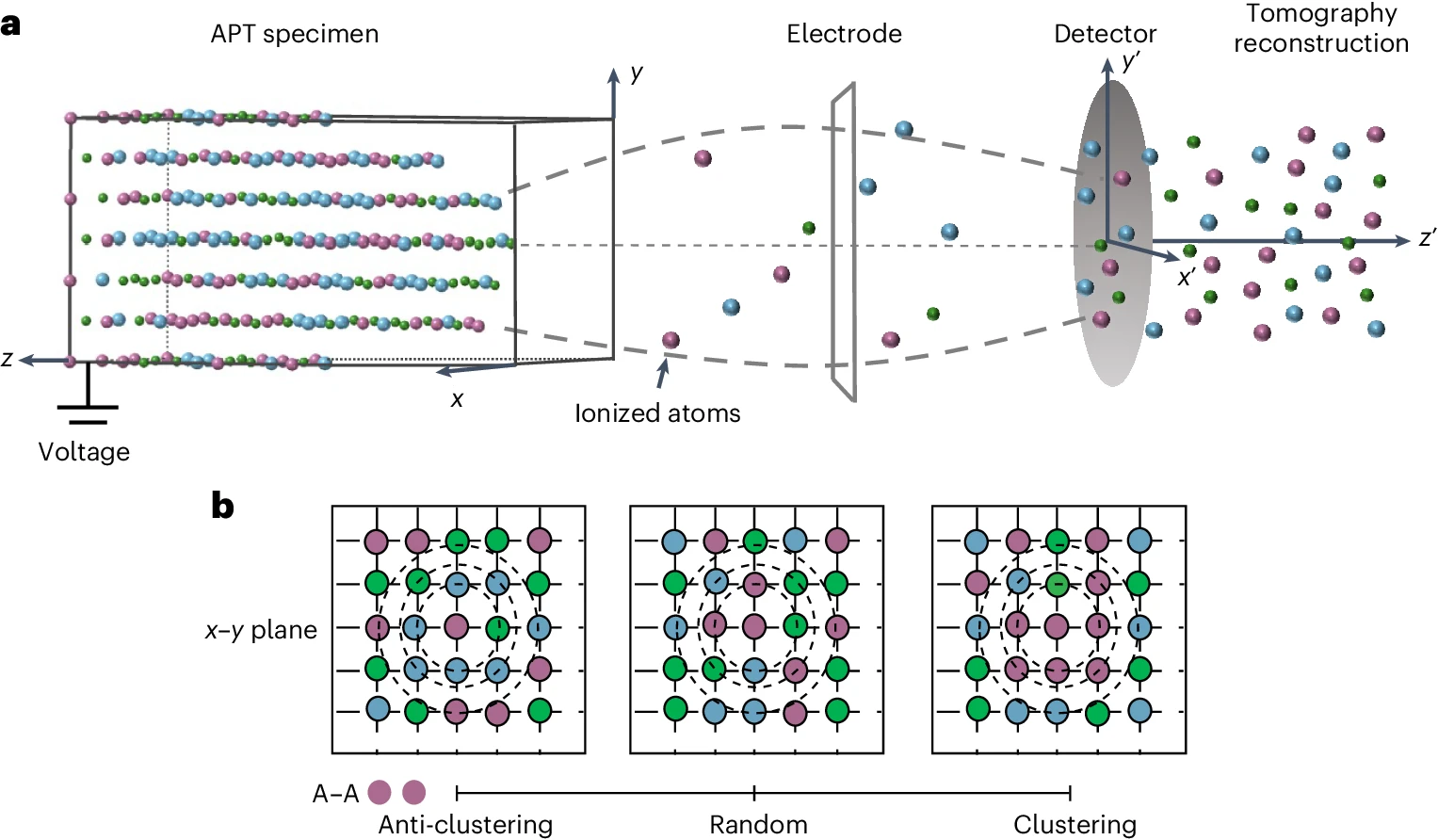
a, APT where the ionization of atoms under a standing field result in their field evaporation towards a detector. Time-of-flight measurements precisely indicate the mass-to-charge ratio, revealing the chemical identity of each individual evaporated ion. A position-sensitive detector enables a tomographic reconstruction atomic layer by atomic layer using a reverse-projection algorithm. Millions (~106–109) of atoms from the analysed specimen can be reconstructed into tomographic atom maps47. The primacy of the issues of ionic trajectory and detector efficiency on the spatial resolution of the tomographic reconstruction is apparent. b, Two-dimensional schematic of anti-clustering, random and clustering SRO behaviours (refer to the purple atom pairs within first NN).
TLDR: Researchers have developed a new method to quantify short-range order (SRO) in high-entropy alloys using atom probe tomography (APT). This method allows for more accurate measurements of atomic arrangements, which are crucial for understanding and improving the mechanical properties of these advanced materials.
In a recent study, scientists have tackled the long-standing challenge of quantifying short-range order (SRO) in high-entropy alloys (HEAs) using atom probe tomography (APT). High-entropy alloys, known for their exceptional strength and ductility, have garnered significant attention in materials science. However, the presence of SRO—where atoms exhibit non-random, preferred arrangements with their neighbors—has been a topic of debate due to the difficulties in measuring it accurately. This study presents a novel approach that overcomes these challenges, providing a clearer understanding of how SRO influences the properties of these materials.
The researchers focused on a medium-entropy alloy, CoCrNi, which is a simpler model for studying HEAs. By applying APT, a powerful microscopy technique that allows for the three-dimensional reconstruction of atomic structures, they were able to map the SRO with unprecedented precision. APT works by ionizing surface atoms of a needle-shaped specimen and projecting them onto a detector, which records their position and identity. This technique is highly sensitive, but its accuracy can be hampered by issues like detection efficiency and trajectory uncertainties of the ions. To address these, the researchers introduced a new computational method that accounts for these limitations, ensuring that the measured SRO reflects the true atomic arrangements in the material.
One of the key findings of the study is that SRO can be engineered through heat treatments. The researchers observed that after annealing the CoCrNi alloy at 500°C for 500 hours, significant changes in SRO were detected. For instance, they found that chromium atoms tended to cluster together, while nickel and chromium showed anti-clustering behavior. These changes in atomic arrangements were linked to improvements in the material’s mechanical properties, such as increased strength and work-hardening capacity.
However, the study also highlights some critical challenges. While the method provides a way to quantify SRO more accurately, it requires careful calibration of the APT instrument and a deep understanding of the material’s response to processing conditions. Moreover, the study’s findings are based on a specific alloy system, and it remains to be seen how well the method can be generalized to other materials. Additionally, the practical implications of manipulating SRO in industrial-scale production of HEAs are still uncertain.
Future research will likely focus on refining the computational models used to interpret APT data, as well as exploring the relationship between SRO and other properties, such as thermal stability and corrosion resistance. There is also interest in applying this method to more complex HEAs and other advanced materials where SRO is expected to play a significant role. By improving our understanding of SRO, scientists can design alloys with tailored properties, potentially leading to new materials with unprecedented performance.
Reference: He, M., Davids, W.J., Breen, A.J. et al. Quantifying short-range order using atom probe tomography. Nat. Mater. (2024). https://doi.org/10.1038/s41563-024-01912-1
Here are five homework problems based on this research:
- Explain the concept of short-range order (SRO) and why it is important in high-entropy alloys.
- Describe how atom probe tomography (APT) works and what challenges it faces in accurately measuring atomic arrangements.
- Discuss the significance of the study’s finding that heat treatment can modify SRO in CoCrNi alloys. What are the potential implications for material properties?
- What are some of the limitations of the APT method described in the study? How might these affect the accuracy of SRO measurements?
- Propose a research experiment to test the generalizability of the SRO measurement method to another high-entropy alloy system.
 Materials Weekly
Leave a comment